Funny Hippie Bus Picture the White House With Solar Panels and Wind Turbine

A wind turbine is silhouetted against the sky at sunset well-nigh Ellsworth, Kansas. The 300-foot-tall turbine is among the 134 units that brand up the Mail Rock Wind Farm. Charlie Riedel/AP hide caption
toggle caption
Charlie Riedel/AP
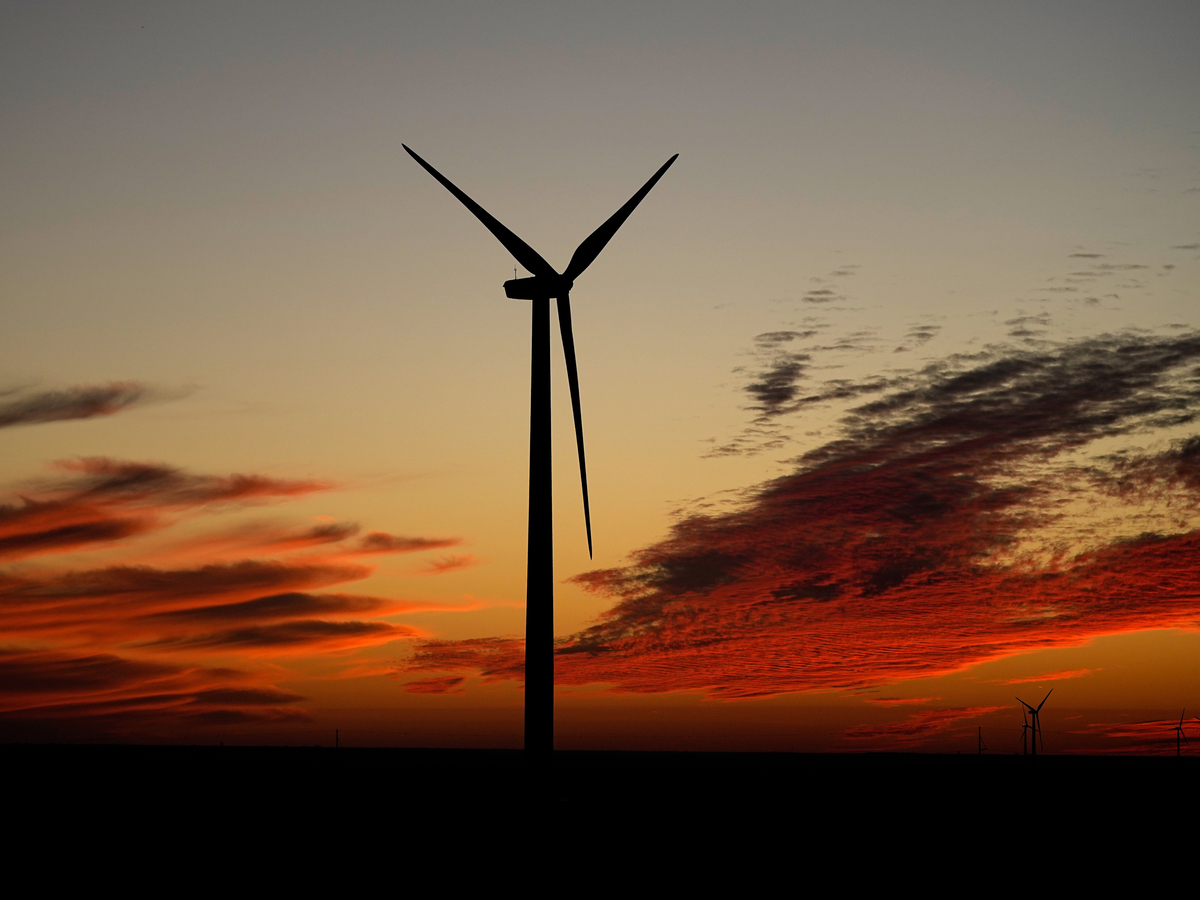
A air current turbine is silhouetted against the heaven at dusk nigh Ellsworth, Kansas. The 300-pes-tall turbine is amongst the 134 units that make up the Post Rock Wind Farm.
Charlie Riedel/AP
On a wintertime nighttime in early on 2016, Jeremy Kitson gathered in his buddy's big shed with some neighbors to plan their fight against a proposed air current subcontract in rural Van Wert County, Ohio. The projection would be about a mile from his domicile.
From the outset, Kitson — who teaches physics and chemical science at the local loftier schoolhouse — knew he didn't want the turbines anywhere near him. He had heard from folks who lived near another air current project about x miles away that the turbines were noisy and that they couldn't sleep.
"In that location were then many people saying that it'due south horrible, you do non want to live under these things,'" Kitson says.
He and his neighbors went on the offensive. "I was simply like, at that place's got to be a way to beat out 'em," he says of the developer, Apex Clean Energy. "You got to outsmart them. You got to figure out the science. You lot got to figure out the economic arguments. You got to figure out what they're going to say and figure out how to counter it."
At the shed, according to Kitson, they agreed that part of their outreach would involve posting data on a Facebook community folio called "Citizens for Clear Skies," which ultimately grew to more than 770 followers.
In between posts selling anti-wind chiliad signs and posts about public meetings opposing local wind projects, there were posts that spread simulated, misleading and questionable information about wind energy. Links to stories about current of air turbine racket causing birth defects in Portuguese horses. Posts about the health effects of low frequency infrasound, too called wind turbine syndrome. Posts virtually current of air energy not actually reducing carbon dioxide emissions. Photos of air current turbines breaking, called-for and falling — some in nearby counties and states, merely some in Germany and New Zealand. According to 2014 data from the Section of Energy, the most recent bachelor, out of the then-40,000 turbines in the U.Southward., there had been fewer than 40 incidents.

An anti-wind turbine sign stands in the front thousand of a farmhouse in Glenville, Minn., in January 2018. Opponents of wind power are successfully stalling or rejecting wind farm projects across the country. Charlie Neibergall/AP hibernate caption
toggle caption
Charlie Neibergall/AP

An anti-wind turbine sign stands in the front one thousand of a farmhouse in Glenville, Minn., in January 2018. Opponents of wind power are successfully stalling or rejecting wind farm projects across the country.
Charlie Neibergall/AP
Kitson, the administrator of the Facebook page, says he knows that these accidents aren't typical. "Those events are not probable. Nosotros know that," Kitson says. But Kitson has seen a broken piece of a fallen turbine bract himself, which got him worrying most how the fiberglass might bear on the integrity of the soil and the crops. Then he posts the photos and articles, many of which he receives from an anti-current of air email listing. "I do that just to try to show people what's possible."
Kitson's group is 1 of dozens in the U.s.a. and abroad that oppose utility-scale wind and solar projects. Researchers say that in many groups, misinformation is raising doubts most renewable energy and slowing or derailing projects.
The opposition comes at a time when climate scientists say the earth must shift chop-chop away from fossil fuels to avoid the worst impacts of climate change. Simply 60% of U.S. electricity still comes from carbon-based fuels.
For the Biden assistants to hit its target of an electricity sector gratis of fossil fuels past 2035, the country has to double or triple the current of air and solar ability chapters it installs over the next few years and maintain that higher level of deployments for near a decade, says Kelly Speakes-Backman, who leads the Energy Department's Part of Energy Efficiency and Renewable Free energy.

President Biden takes notes during a meeting to discuss clean free energy efforts with CEOs of U.S. electrical utility companies at the White House in February 2022. Anna Moneymaker/Getty Images hide caption
toggle caption
Anna Moneymaker/Getty Images

President Biden takes notes during a coming together to talk over make clean energy efforts with CEOs of U.South. electric utility companies at the White House in February 2022.
Anna Moneymaker/Getty Images
However every single rural utility-scale current of air and solar project needs local or country approving to get built, says Sarah Mills, who researches rural renewable free energy at the University of Michigan. And she says information technology'south in those ofttimes-fractious discussions most approval that misinformation is sometimes halting and stalling the installation of the renewables the climate needs. "At the finish of the mean solar day, if local governments are not setting rules that allow for the infrastructure to exist sited, those policies cannot exist achieved," Mills says.
Misinformation gets mixed upwards in decisions over renewable projects
Final year, a Section of Energy study found that setback regulations now represent the unmarried-greatest barrier to securing locations for wind projects in the U.Southward. Setbacks limit how close air current projects can exist to buildings, and Mills says they often brand sense to reduce things such as noise and "shadow flicker," the moving shadows and strobing sunlight that turbines can bandage onto buildings. But she says misinformation can fuel setbacks that are more stringent than needed and sometimes act every bit outright bans on renewable energy.
In Ohio, setbacks and other rules associated with renewable projects take historically been fix at the state level. Only in October, a new law, SB 52, went into effect giving counties the ability to make exclusion zones with no utility-scale wind and solar projects.
Kitson, the science instructor, testified in back up of the zones, arguing that turbines negatively affect holding values. He pointed to his group'southward analysis comparison the lower property values in the ane local township that has wind turbines to the higher boilerplate property values in the greater county.
But Ben Hoen, a researcher at the Lawrence Berkeley National Laboratory, says his more than 15 years of research has shown that wind turbines accept little to no bear on on nearby property values. Hoen says, "We have not found evidence of property value impacts despite studying it over multiple periods of time."

Wind turbines dot the countryside in Okarche, Okla., in 2021. Sue Ogrocki/AP hide caption
toggle explanation
Sue Ogrocki/AP

Wind turbines dot the countryside in Okarche, Okla., in 2021.
Sue Ogrocki/AP
Hoen does say that studies in the Netherlands and United kingdom of great britain and northern ireland accept found some effects on property values, but they were far smaller than Kitson'southward reference to studies showing a 20%-40% depreciation.
In almost half of states, regulations effectually how and whether to build rural utility-calibration solar and wind are adamant on the local level, Mills says. "These local officials are not necessarily experts in energy," she says. "And so when you accept people coming and stating things as facts, especially if there'south nobody fact-checking everything, right, it's difficult. They're certainly making decisions based on what they're hearing."
Facebook groups spread misleading content
In recent years, some of the misinformation almost renewable energy has come from former President Donald Trump, who frequently makes misleading and faux anti-wind claims at his rallies and media appearances, including the untrue idea that wind turbine dissonance causes cancer. Before this calendar month, when asked nigh the unfolding Ukraine crunch on a podcast, Trump immediately responded by listing untrue ideas virtually current of air energy.
Other misleading ideas about renewable free energy come from groups with ties to the fossil fuel industry, like the Texas Public Policy Foundation. The foundation recently released a film trailer for an anti-offshore wind group in Massachusetts that features multiple falsehoods, including the untrue statement that the proposed project didn't exercise any environmental impact assessments and the incorrect idea that offshore air current projects "oasis't worked anywhere in the world." The Texas Public Policy Foundation did non answer to a asking for comment.
But Facebook is one of the biggest drivers of misleading content about renewable energy, says Josh Fergen, a researcher at the Academy of Minnesota Duluth. Last fall, Fergen and his colleagues published a paper looking at the Facebook posts of Kitson'south group and another large wind opposition grouping, nearly 90 kilometers east, fighting the Republic Wind Farm.
Fergen's paper concluded that posts in the ii Facebook pages were "increasing perceptions of human health and public safety risks related to current of air past sharing news of disasters and misinformation over health assessment risks." In June, the Ohio Ability Siting Board, whose blessing was needed for the site, rejected the Republic Wind Subcontract proposal citing geological concerns and the local opposition.
NPR reviewed dozens of posts from anti-wind and anti-solar groups. While some posts most climate change deprival, lithium mining, and a quote misattributed to Winston Churchill were marked as inaccurate, there were dozens of posts with misleading information about renewable free energy that were non tagged.
NPR sent Facebook a sampling of the posts from anti-renewable community pages. Facebook spokesman Kevin McAlister said in an emailed statement, "We take action against content that our fact-checking partners rate faux equally part of our comprehensive strategy to keep viral, provably false claims from spreading on our apps. The examples shared with united states don't appear to meet that threshold every bit they have only even been shared a handful of times over a menstruum of several years."
But Fergen says that these same types of misleading and imitation posts virtually wind and solar energy pop upwards in a network of Facebook groups effectually the country, feeding a conflict betwixt rural communities and energy developers.
Leah Stokes, an acquaintance professor of political science at the University of California, Santa Barbara, says as resistance to wind and solar projects spreads on social media, the dangers of misinformation from these anti-renewable Facebook groups is growing.
"It tin really slow down the clean free energy transition, and that has just every bit dire life and death consequences, not just in terms of climate alter, but also in terms of air pollution, which overwhelmingly hits communities of color."

Lobstermen and their families attend a 2021 rally to protest Maine Gov. Janet Mills' support for offshore wind projects in Augusta, Maine. Robert F. Bukaty/AP hide caption
toggle caption
Robert F. Bukaty/AP
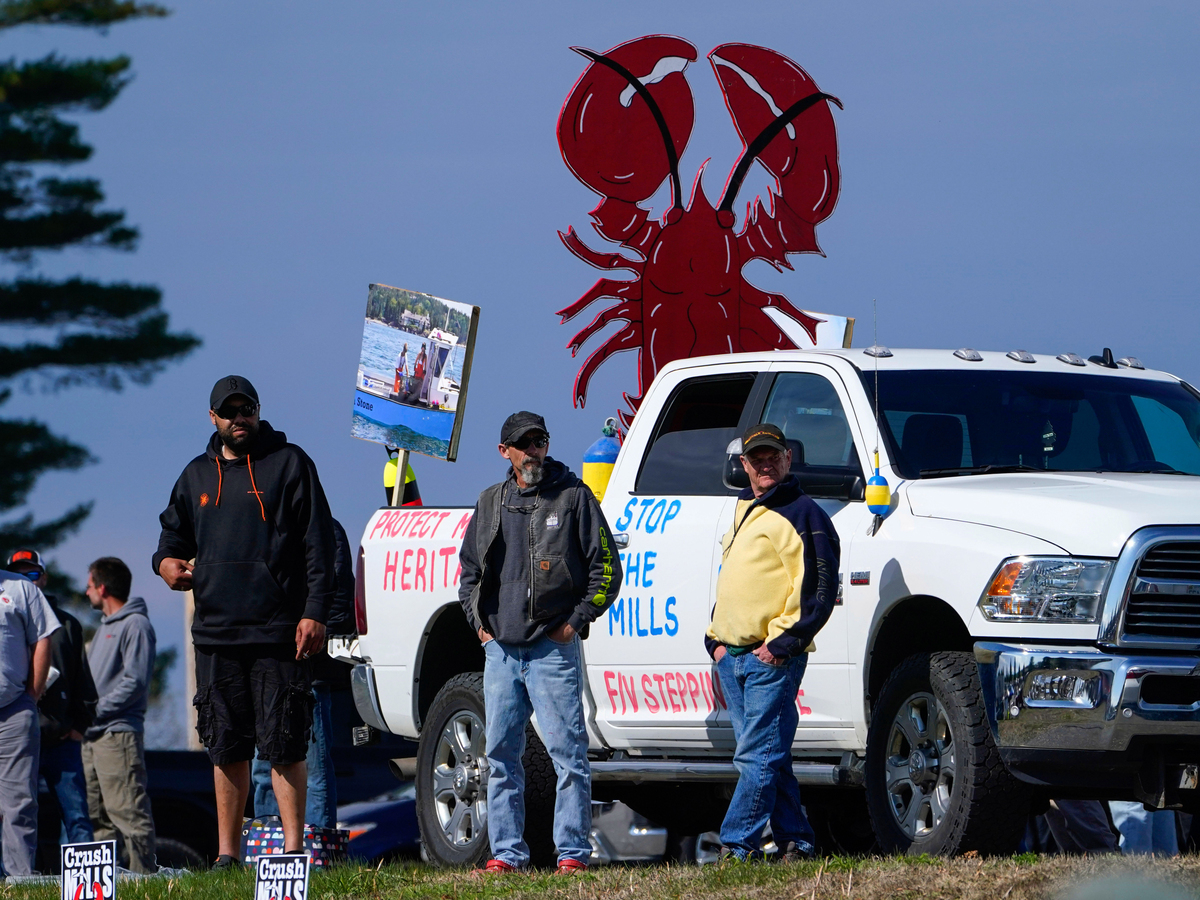
Lobstermen and their families nourish a 2021 rally to protest Maine Gov. Janet Mills' support for offshore wind projects in Augusta, Maine.
Robert F. Bukaty/AP
"It's almost who you lot trust"
Speakes-Backman says the Department of Energy is trying to practise more outreach to local communities about inaccurate ideas surrounding utility-scale solar and wind, especially around country utilise and environmental furnishings. "We want to brand sure that nosotros are counteracting the misinformation that may be out there," she says.
But Dahvi Wilson, vice president of public affairs for Noon Make clean Energy, says her company is finding that across the state, local engagement is becoming increasingly difficult given customs suspicions of renewable energy.
"I recall for a long time, and mayhap still in some places, developers idea, 'Well, nosotros only need to give better information. We but need to give more information.' And it's like, 'it's so not about that at all!'" Wilson says. "Information technology'south virtually who y'all trust and if anybody's going to believe yous if you're a company."
Hoen of the Lawrence Berkeley National Laboratory says the perception of the customs engagement procedure regarding renewables has real implications — even on human health. He gives the example of shadow flicker, the moving shadows from turbines, which opposition groups frequently cite when critiquing wind. A few states and several counties accept regulations limiting shadow flicker on habited structures, commonly to about 30 hours per year, but almost practice not, and air current opposition groups contend that the strobing shadows can cause agitation, headaches, or even seizures in some individuals.
Hoen says to date they accept not found any evidence of shadow flicker causing seizures in research they've reviewed, but they take found its relation to annoyance and stress. So Hoen'southward group did a study asking: "As the number of shadow flicker hours subtract, is there less annoyance? Are people less bothered by it?"
"What we plant, interestingly, is that the individuals that were annoyed by shadow flicker did not necessarily accept a college level of shadow flicker at their abode than those that weren't bellyaching," Hoen says. Another report found stress symptoms were correlated with how people felt about the fairness of the project's roll-out. "And, in fact, what led to that badgerer, it appears, is their perception of the planning process, how they felt like that development got rolled out in their community."
Given the importance of community engagement in the process of locating wind and solar, Mills says renewable proponents need to exist careful that they aren't romanticizing the projects or providing misleading information themselves, for example, by saying that a wind or solar found will bring lots of jobs to an surface area.
"There are a lot of jobs in renewable energy. Many, many of the jobs in renewable energy are in construction trades. And so once the project is built, in that location's not tons of jobs associated with the project," Mills says. "I call back in all of this, information technology'due south of import to not sugarcoat."
Anti-renewable groups have internal disputes over use of misinformation
In the last few months, more states — Washington, Iowa and Kansas — take proposed bills to restrict rural utility-calibration wind and solar. In Kansas, these bills were proposed by state Sen. Mike Thompson, who also introduced a bill to shut down existing renewable projects.
Thompson, a one-time meteorologist, is a longtime critic of renewable energy. One of his anti-air current videos fifty-fifty popped up on Kitson's anti-wind Facebook group.

Kansas Republican state Sen. Mike Thompson (left) during a 2022 meeting at the Statehouse in Topeka. Thompson denies the link between human activity and climate change and has a primal function in energy policy as the state Senate'south utilities committee chairman. John Hanna/AP hide caption
toggle caption
John Hanna/AP

Kansas Republican state Sen. Mike Thompson (left) during a 2022 meeting at the Statehouse in Topeka. Thompson denies the link between human activity and climate change and has a key function in free energy policy as the state Senate'southward utilities committee chairman.
John Hanna/AP
In ane video on the anti-solar group's YouTube channel, Thompson calls climate change "i of the biggest scams out there" and says "carbon dioxide has no correlation with the temperature on this planet whatsoever." That statement is fake: The vast bulk of scientists agree that the climate crisis stems from greenhouse gas emissions generated by homo action. Thompson did non respond to requests for comment.
YouTube spokesperson Elena Hernandez said in an emailed statement, "In general, we don't recommend or prominently surface content that includes climate change misinformation. Our systems are trained to raise videos from authoritative sources, like news outlets and experts, in search results for sure queries related to climatic change and renewable energy."
Barbara Kerr is a professor of psychology at the University of Kansas and she's a founding member of that anti-solar grouping in Kansas, which opposes NextEra Energy's proposed utility-scale solar establish in Douglas and Johnson counties. Kerr says she knows the videos that take been featured by the group she co-founded have misinformation.
"Simply horrible," Kerr says of the videos. "They are merely counterfactual and not something we should accept on the website."
But despite Kerr'south objections, her group decided in January to keep the videos online. "Information technology is important to not judge, and censor utility-scale solar content/opinions contributed by citizens. If we become judge and jury, we are headed down the wrong path," the group said in an emailed argument.
Kerr says that while she disagrees with the misinformation used past some in her grouping, she says the anti-solar coalition makes for "foreign bedfellows." "Sometimes you have to compromise," she says. "I don't want to alienate these people. They go to the meetings in Douglas Canton and Johnson County."
Simply Dan Reuman, professor of ecology and evolutionary biology at the University of Kansas, says he worries about the role misinformation could play in the controlling over the solar project, which he supports. He says that while he is sympathetic to those in his canton who don't desire to alive well-nigh a large-calibration solar establish, he also thinks their concerns demand to be weighed against the need to mitigate climate alter.
"I just notice it upsetting," Reuman says. "I hope that the government doesn't make a compromise between a scientifically based position and a misinformation-based position. Because if yous're compromising with misinformation, then there'southward sort of no limit to that, right?"

A windfarm almost Velva, N.D. The 213-foot wind towers are owned by Global Renewable Free energy Partners and Acciona Energia and purchased by Xcel Energy, which distributes the wind-generated electrical power to its Due north Dakota customers. Karen Bleier/AFP via Getty Images hide explanation
toggle caption
Karen Bleier/AFP via Getty Images

A windfarm near Velva, Due north.D. The 213-foot wind towers are owned past Global Renewable Energy Partners and Acciona Energia and purchased past Xcel Free energy, which distributes the wind-generated electric ability to its Northward Dakota customers.
Karen Bleier/AFP via Getty Images
Editor'due south note: Facebook'due south parent company, Meta, pays NPR to license NPR content.
Source: https://www.npr.org/2022/03/28/1086790531/renewable-energy-projects-wind-energy-solar-energy-climate-change-misinformation
0 Response to "Funny Hippie Bus Picture the White House With Solar Panels and Wind Turbine"
Post a Comment